Abstract
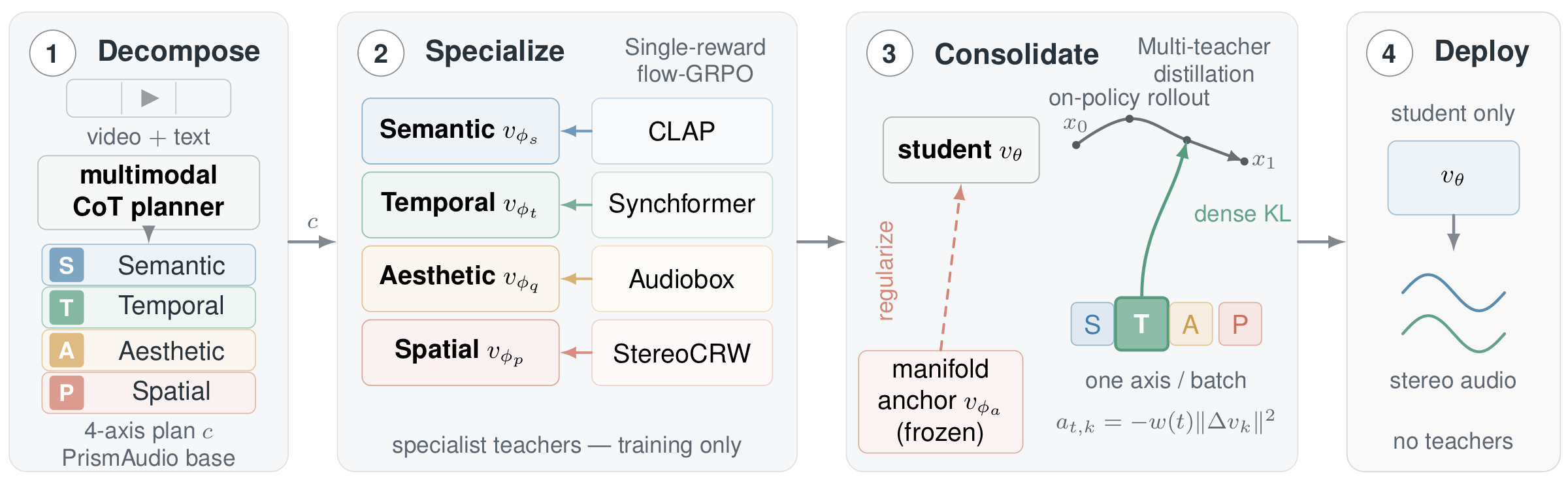
Video-to-audio (V2A) generation aims to produce a single soundtrack that is simultaneously semantically faithful, temporally synchronized, aesthetically natural, and—for stereo output—spatially accurate. These perceptual axes are judged on the same waveform yet often pull generation in locally conflicting directions, while the dominant post-training recipe—reinforcement learning (RL) from an aggregated scalar reward—supervises them only at the final waveform with one entangled signal that gives little indication of which axis failed or where, so competing axes interfere through a single advantage value. We present MosaicAudio, a V2A framework that replaces terminal scalar rewards with dense, per-axis supervision distilled on-policy. MosaicAudio first trains four specialist flow-matching teachers, one per perceptual axis, then consolidates them into a single student: the student samples its own denoising trajectories and, at each visited state, receives a full teacher velocity field routed to one axis at a time, so that incompatible corrections are not averaged together. A perceptual manifold anchor keeps the student on a high-fidelity audio prior and curbs reward hacking during alignment. On the in-domain VGGSound test set and the out-of-domain AudioCanvas benchmark, MosaicAudio achieves state-of-the-art performance among compared V2A systems across objective metrics and human ratings, with especially consistent gains in complex multi-event scenes.
Main Results
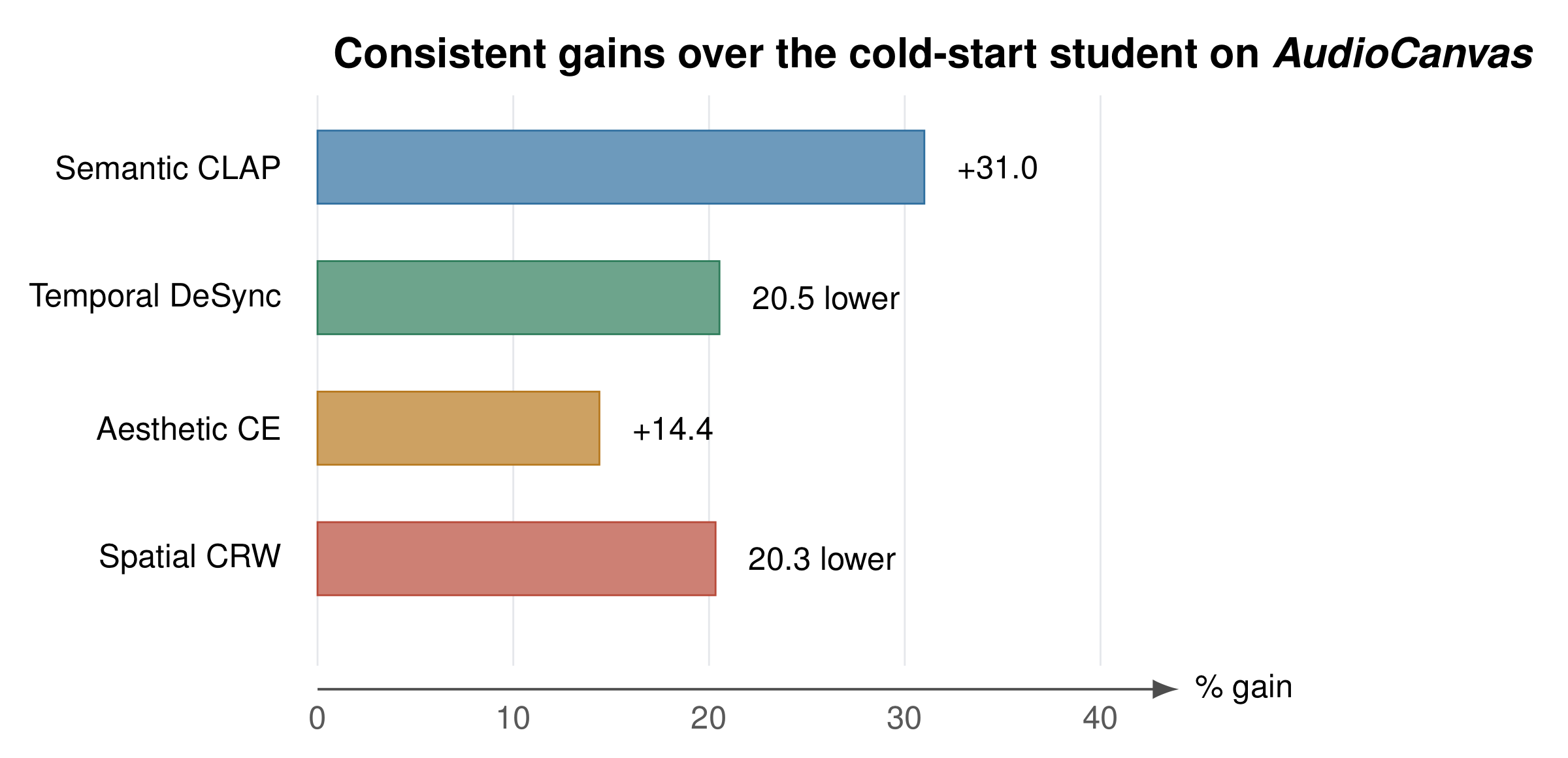
Key metrics on VGGSound (in-domain) and AudioCanvas (out-of-domain).
MosaicAudio w/o OPD is the shared decomposed-CoT cold start before any post-training.
“—” marks a mono baseline without a stereo channel (CRW) or a method not evaluated on that benchmark. Ground truth (GT) is shown for reference only.
| Method |
VGGSound (in-domain) |
AudioCanvas (out-of-domain) |
| CLAP ↑ | DeSync ↓ | CE ↑ | CRW ↓ | MOS-C ↑ |
CLAP ↑ | DeSync ↓ | CE ↑ | CRW ↓ | MOS-C ↑ |
| Ground truth |
0.46 | 0.55 | 4.40 | — | 4.65 |
0.48 | 0.40 | 4.02 | — | 4.72 |
| Frieren |
0.32 | 0.85 | 3.57 | — | 3.51 |
— | — | — | — | — |
| V2A-Mapper |
0.31 | 1.23 | 4.12 | — | 3.44 |
— | — | — | — | — |
| AudioX |
0.41 | 1.24 | 3.86 | 19.25 | 3.65 |
— | — | — | — | — |
| HunyuanVideo-Foley |
0.42 | 0.55 | 3.92 | — | 3.96 |
0.44 | 0.47 | 4.04 | — | 3.71 |
| MMAudio |
0.40 | 0.46 | 3.88 | — | 4.03 |
0.46 | 0.43 | 3.97 | — | 3.87 |
| ThinkSound |
0.43 | 0.55 | 3.95 | 13.47 | 4.18 |
0.48 | 0.80 | 4.10 | 22.82 | 3.80 |
| PrismAudio |
0.47 | 0.41 | 4.29 | 7.72 | 4.22 |
0.52 | 0.36 | 4.26 | 12.87 | 4.01 |
| MosaicAudio w/o OPD |
0.42 | 0.51 | 3.94 | 10.29 | 4.11 |
0.42 | 0.44 | 3.81 | 15.30 | 3.85 |
| MosaicAudio |
0.50 | 0.38 | 4.64 | 7.11 | 4.25 |
0.55 | 0.35 | 4.36 | 12.20 | 4.13 |
Bold blue marks the best result per column. The automatic proxies (CLAP, DeSync, Audiobox CE) are not calibrated upper bounds, so post-training can exceed GT on the metrics it directly optimizes.